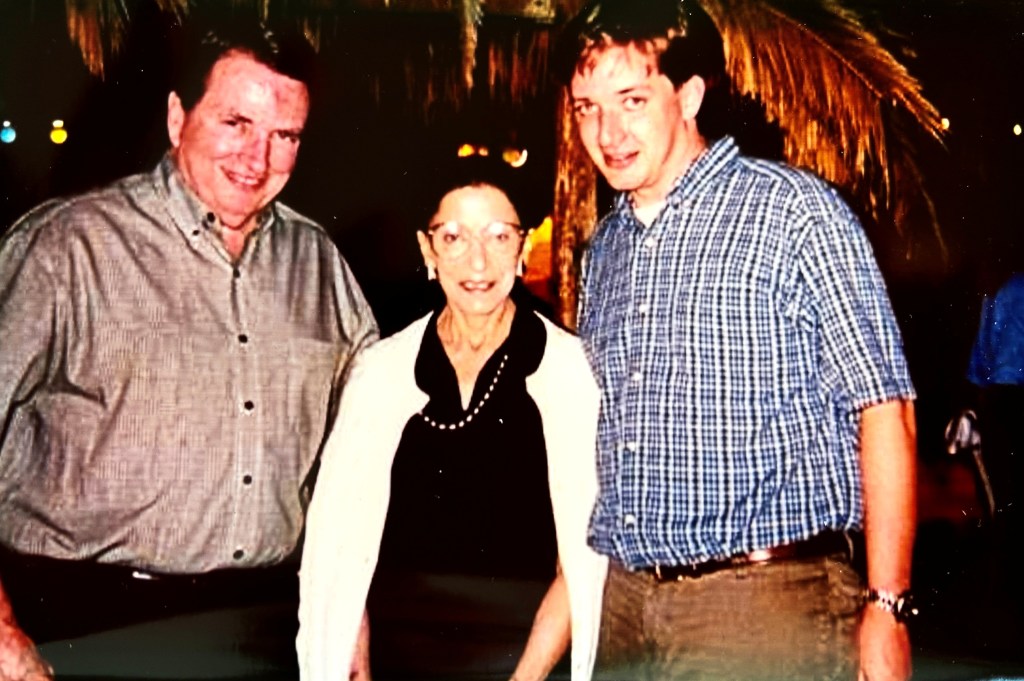
As of yesterday, February 23, 2026, Judge James L. Dennis, who took senior status in December 2022, has taken full inactive senior status. Judge Dennis has long been a giant in the law.
Judge Dennis was born in January 1936, in Monroe, LA. After serving in the United States Army from 1955-1957, he attended Louisiana Tech University and then LSU Law School, from which he earned his J.D. in 1962. While working in private practice, in 1968 he was elected as a representative to the Louisiana legislature; and in 1972 was first elected to the bench, as a district court judge in Louisiana’s Fourth Judicial District. In 1974, he was elected to his first appellate post, as a judge with the Louisiana Second Circuit Court of Appeal, and also was a delegate at the constitutional convention resulting in the 1974 Constitution of Louisiana. Among his notable contributions to that document was Article IX, subsequently recognized (first in a 1984 Louisiana Supreme Court decision authored by then-Justice Dennis, Save Ourselves, Inc. v. Louisiana Environmental Control Commission, and then in many decisions thereafter) as the manifestation of a constitutional public trust doctrine for Louisiana. In 1975, he was elected as an Associate Justice to the Louisiana Supreme Court, where he served for twenty years in a time noted for justices of astute legal scholarship (including Justices Albert Tate, Mack Barham, Pascal Calogero, Revius Ortique, and Harry Lemmon, among many others).
Judge Dennis was nominated to the U.S. Court of Appeals for the Fifth Circuit in 1995 by President Bill Clinton, and confirmed later that year. He assumed senior status in December 2022, and his active-status seat on the Court was then filled by Judge Dana Douglas.
I had the good fortune to intern for Judge Dennis after my first year at Tulane Law School in 1998, to be a research assistant during my second year of law school to him and Justice Ruth Bader Ginsburg as they teamed up to construct and deliver a class on comparative human rights law at Tulane’s summer program in 1999, and then to serve as a judicial law clerk to him after I graduated, in 2000-2001, a quarter-century ago. Judge Dennis’s judicial approach (both then, when I clerked for him, and up through his taking inactive status yesterday) was not to enter into any case with a preconceived result, but to dig deeply into the record in every case and to research even more deeply into the law and into the antecedents and context for the law at issue, with that thorough approach often reflected in opinions of rigorous and scrupulous analysis. His final opinion issued before taking inactive senior status was a dissenting opinion from the en banc result in Roake v. Brumley on February 20, 2026.
When Judge Dennis’s former clerks were informed that the Judge’s taking of inactive status was impending, many of us penned letters and tributes to be collected and sent to him. I would like to share mine here, because he has meant a great deal to me and my development as a lawyer and as a person:
Re: Your inspiring career and your profound effect on me
Dear Judge Dennis,
Thank you.
Thank you for being a judge who never loses sight of the foundational fact that laws govern human beings, that no one human being is more deserving of the protections of the law than another human being, that all people have a dignity deserving the respect of the law, the makers of the law, and the interpreters of the law. In your more than thirty years at the Fifth Circuit, more than twenty years on the Louisiana Supreme Court, and your time at the district court and the La. Second Circuit before that, this foundational fact has been the guiding force of your jurisprudence.
Thank you for giving Louisiana law a public trust doctrine that means something, first as a member of the 1974 constitutional convention that gave us Article IX, § 1, and then as the Justice who authored Save Ourselves, Inv. v. La. Envt’l Control Com’n, 452 So. 2d 1152 (La. 1984).
Thank you for your dissenting opinion in Allison v. Citgo Petroleum Corp., 151 F.3d 402 (5th Cir. 1998); and thank you for letting me, then a wet-behind-the-ears summer law student intern, assist you in your drafting of that dissent. And thank you for sending me a kind note several years later when that dissent was cited in support of the Second Circuit’s disagreement with Allison, in its decision in Robinson v. Metro-North Commuter R.R. Co., 267 F.3d 147 (2d Cir. 2001).
Thank you for all of your dissents. Thank you for holding the Court accountable to the law and letting nothing slide through that was not a result fully supported by the law.
Thank you for your thorough approach to the law, the demand that your clerks research and understand every historical precept and every policy concern of any law that touches on a dispute brought before you. Thank you for believing that the litigants, the people, require nothing but our hardest work, with never a short-cut or a moment of relaxation from the rigors of law.
Thank you for your equally thorough approach to the record of each case. In the quarter-century since I left my clerkship service in your chambers, I have never worked harder than I did there and then; though the diligence and thoroughness I learned from you color everything I do in my practice and in my expectations of those with whom I practice.
Thank you for the moments of kindness that went hand-in-hand with your demands for thoroughness and hard work. I have innumerable mental snapshots of those moments: you and your then-clerks (Scott Arceneaux, Phoebe Roaf, Celeste Coco-Ewing, and Jennifer Rodgers) bringing me to the Columns for a drink at the end of the first week of my internship; you bringing me in to assist you and Justice Ginsburg when y’all co-taught that class on Comparative Human Rights Law in Crete; your bringing Nicole and me down from a very windy and cold top-deck to rest in your cabin on the ferry ride from Crete to Santorini. And then a hundred simple lunches around the table in the little kitchen area at the back of your chambers with our clerkship group (Ron Scalise, Kelly Titus, Heather Bruner, and me), with you asking about us and our lives, and with you sharing stories about your time in the legislature and in the courts, giving us a window into the way the world we were entering works. Your smiles. Your chuckle.
Thank you for so many moments, for so many decisions, for so many lessons.
As you know, I had a traumatic and dramatic bicycle wreck not even a full year ago (and actually another one a few months after that), from which I am still not fully recovered. One of the silver linings for me from that, is that I am filled with gratitude. But even in that filled state of gratitude, my gratitude for you has its own special place. Thank you, Judge Dennis, for all you are and have been.
All best, Tad Bartlett
 Take the Fifth